Why are traditional infrastructure platforms struggling to keep pace with today’s AI-driven business demands? Legacy systems built with rigid architectures and siloed operations simply cannot adapt to the dynamic requirements of modern enterprises. These inflexible foundations create bottlenecks that impede innovation, limit scalability, and disconnect technology investments from business outcomes.
Legacy infrastructure hinders innovation, creating bottlenecks that disconnect technology from business outcomes in today’s AI-driven landscape.
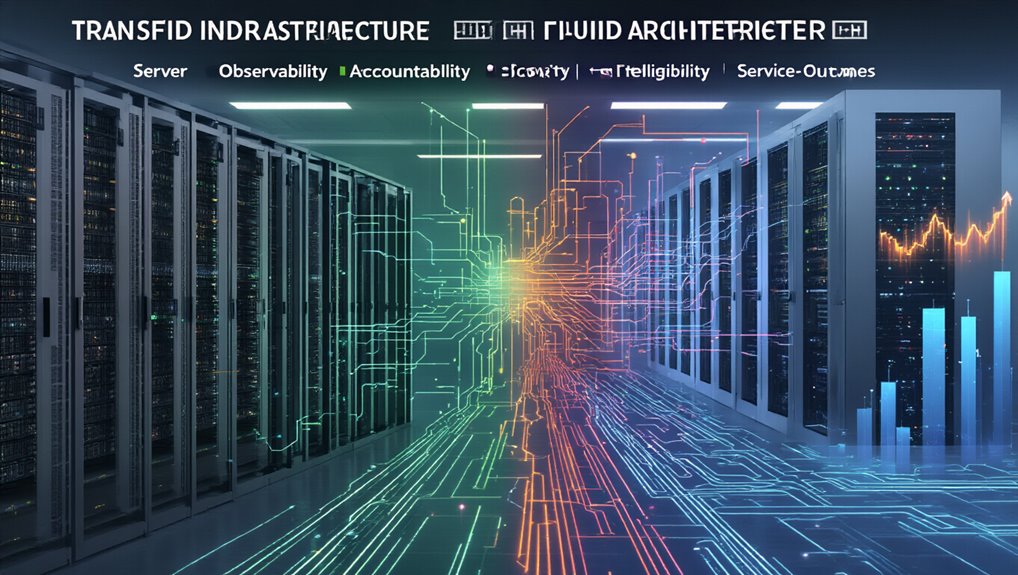
Forrester’s OASIS Framework offers an all-encompassing solution to this challenge by reimagining infrastructure as outcome-driven platforms. The framework consists of five essential capability areas: Observability, Accountability, Security, Intelligibility, and Service-driven design. Together, these elements transform static infrastructure into responsive platforms that directly support business objectives. Organizations implementing OASIS can reduce operational friction while increasing agility and efficiency. The rapid adoption of Agentic AI is accelerating the need for enterprise infrastructure transformation. Traditional platform engineering approaches must evolve to incorporate embedded operational controls that mitigate risks from AI agents, security threats, and unauthorized AI usage.
The five OASIS capabilities work as an integrated system. Observability provides real-time insights across all platform components, enabling proactive management. Accountability ensures all automated actions maintain proper governance and traceability. Security controls are embedded throughout to protect AI-driven operations. Intelligibility makes complex systems understandable to both human operators and AI agents. Service-driven design exposes infrastructure functions as composable services for seamless automation. Integration platforms provide real-time synchronization between disparate systems, ensuring data consistency across applications.
This approach delivers tangible business benefits. Companies adopting OASIS principles typically experience:
- Accelerated time-to-value for new initiatives
- Enhanced responsiveness to market changes
- Lower operational risk through improved controls
- Greater efficiency through intelligent automation
The framework guides implementation through structured, phased adoption. Technology leaders can modernize existing infrastructure progressively while maintaining operational continuity. This practical approach has gained traction across industries where scalability, security, and compliance are paramount concerns.
OASIS represents a pivotal shift from managing technology components to enabling business outcomes. By creating infrastructure platforms that are inherently AI-ready, organizations position themselves to leverage emerging technologies effectively. In an era where business agility determines competitive advantage, OASIS provides the foundation for sustainable innovation and growth.