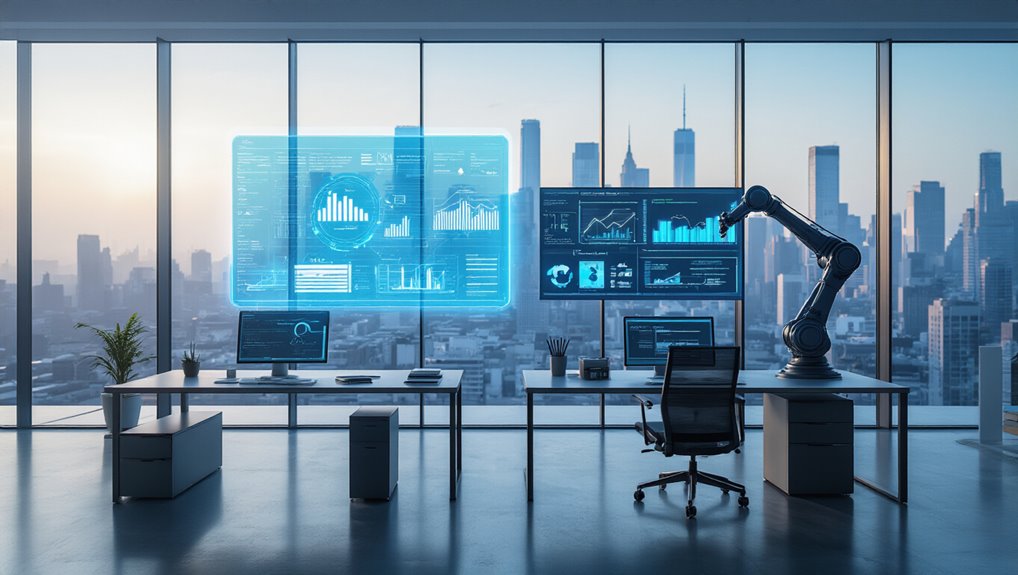
How rapidly is artificial intelligence transforming the modern workplace? The statistics paint a clear picture of acceleration. The global agentic AI market is projected to grow from $5.25 billion in 2024 to a staggering $199.05 billion by 2034, representing a compound annual growth rate of 43.84%.
The workplace revolution is here—AI’s explosive growth signals not just change, but transformation at unprecedented scale.
Currently, 79% of organizations report some level of agentic AI adoption, with nearly all planning expansion in 2025.
The productivity gains are substantial. Organizations implementing agentic AI report average employee productivity increases of 30%. This translates to a 19% reduction in labor costs, equivalent to $11,064 per employee based on OECD average wages. The impact is magnified by the fact that only 15% of organizations have fully implemented agentic AI so far.
Real-world applications already show AI agents processing thousands of documents in seconds and debugging complex code that would take humans considerably longer.
You’ll find the workforce composition shifting as AI becomes more prevalent. Most workers (61%) will remain in their current roles while collaborating with digital labor. Nearly a quarter will be redeployed to new positions. This transformation is happening faster than anticipated, with 73% of HR leaders already preparing for this AI-driven workplace evolution.
HR leaders recognize this shift, with 81% planning to reskill employees for better opportunities in the digital labor era. Similar to modern outsourcing trends, the focus has shifted from cost reduction to accessing specialized talent and improving operational efficiency.
Employee attitudes toward agentic AI are largely positive. About 84% express enthusiasm to embrace these technologies in their roles. Among desk workers already using AI agents, 90% report confidence in their abilities to work alongside them.
However, concerns persist—56% worry about job security, and 51% fear obsolescence.
The transformation extends beyond productivity to strategic evolution. Organizations are rethinking how teams function when human and digital workers collaborate.
HR chiefs increasingly view redeployment as more cost-effective than external hiring, with 88% supporting this approach.
These trends point to a future workplace where your most influential colleague might be digital. While adoption varies across industries, the trajectory is clear: agentic AI is becoming an essential workplace partner, augmenting human capabilities while reshaping organizational structures and career paths.