



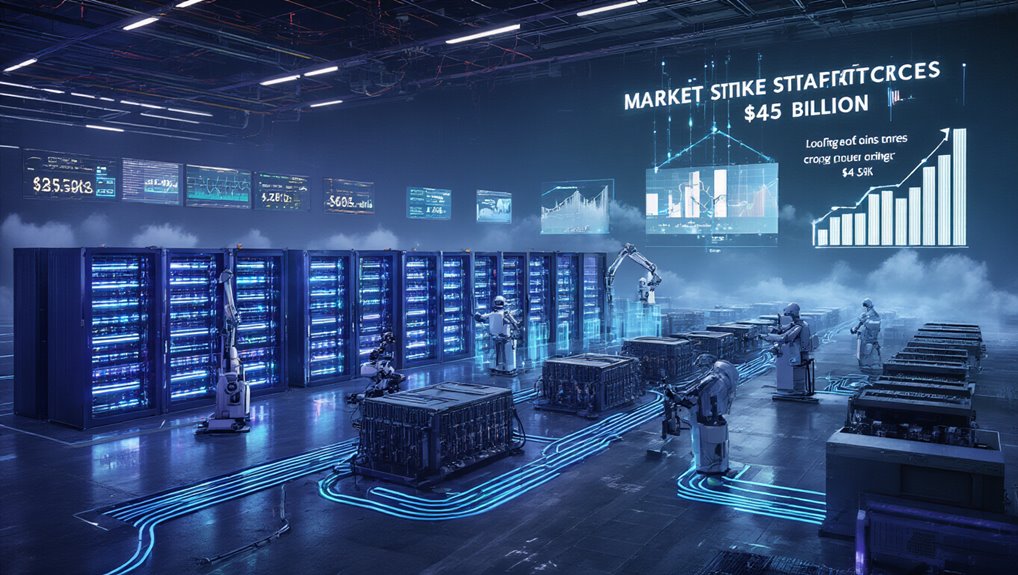
As the autonomous AI agent market approaches $8.5 billion in 2026, fierce competition is erupting across multiple fronts in managed services. Industry forecasts suggest this market will expand dramatically to $35 billion by 2030, with enterprise orchestration potentially boosting this figure by 15-30% to approximately $45 billion.
The AI agent market’s explosive growth to $45 billion by 2030 is igniting fierce competition across managed services.
This explosive growth is attracting major players who recognize the strategic importance of controlling the AI service layer.
The battleground centers on inference computing, which will constitute two-thirds of all AI computing power by 2026. Data centers valued at nearly half a trillion dollars will host most inference workloads, while on-premises servers will utilize $200 billion worth of power-intensive AI chips. Cross-industry collaboration involving energy, manufacturing, defense, healthcare, and government sectors will be crucial to address the immense power and infrastructure demands.
Companies that can efficiently manage these resources will gain significant advantages in cost structure and performance capabilities. Many organizations are shifting to variable expense models through outsourcing non-core AI functions to specialized providers.
Enterprise-wide AI strategies are becoming essential for competitive advantage. Organizations are establishing centralized AI studios targeting high-ROI workflows in demand sensing, personalization, and finance. These studios provide three critical components:
- Reusable technology frameworks
- Use case templates
- Testing environments for safe experimentation
Governance represents another critical battlefield. Half of enterprise ERP vendors will launch autonomous governance modules featuring explainable AI and audit trails by 2026. SAP, Microsoft, and Oracle are investing heavily in these capabilities, recognizing that governance will be essential for mission-critical AI applications.
The economics of AI managed services are changing rapidly. As costs escalate, providers must focus on high-value use cases and “superagents” that deliver measurable ROI. Traditional SaaS pricing is evolving toward hybrid consumption- and outcome-based models, especially as agentic AI disrupts conventional software paradigms.
Energy constraints will further intensify competition. Global data center power consumption will reach 1,050 TWh by 2026, creating bottlenecks in infrastructure expansion. Successful providers will implement token-based approval systems to optimize AI energy use while maintaining performance.
The most successful managed service providers will be those who optimize for energy efficiency while delivering high-performance AI capabilities across distributed computing environments.