



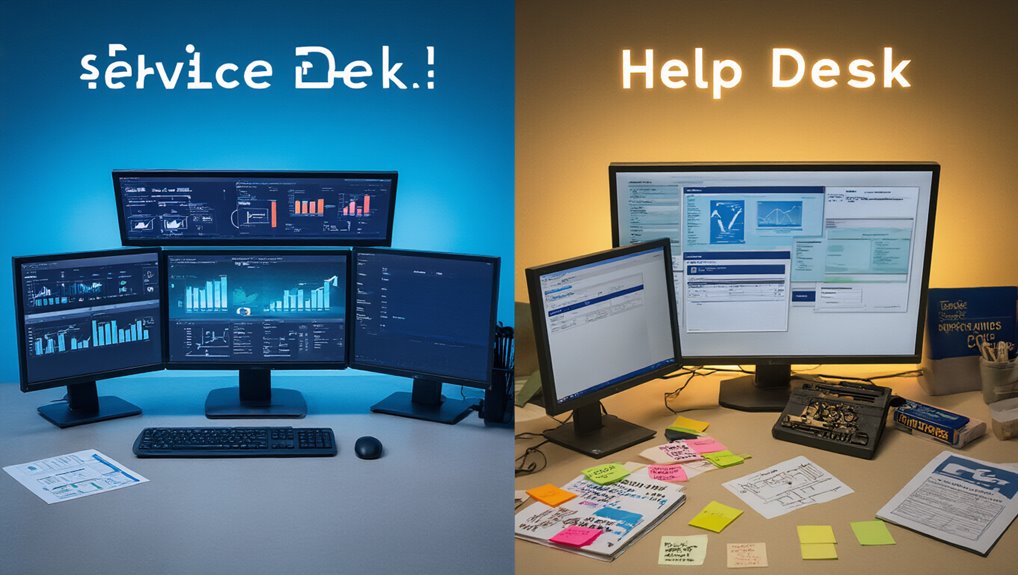
While often used interchangeably, service desks and help desks represent distinctly different approaches to IT support within an organization. Help desks typically offer a narrower scope of support, focusing primarily on resolving immediate technical issues through a reactive, break/fix approach. They excel at addressing user problems quickly but lack the strategic vision and broader process integration that modern businesses require.
Service desks provide strategic, holistic IT support, while help desks offer reactive troubleshooting without broader business integration.
Service desks, by contrast, provide holistic support that extends beyond simple troubleshooting. They manage the entire IT service lifecycle, including incident, problem, change, and request management. This thorough approach allows service desks to identify patterns, prevent recurring issues, and align IT services with business objectives.
You’ll find that service desks act as a single point of contact for all service-related interactions, creating consistency and accountability across your organization.
The distinction becomes clearer when examining their impact on business outcomes. Help desks minimize downtime through rapid issue resolution, which is certainly valuable. However, they rarely engage in proactive problem management or root-cause analysis.
Service desks drive overall service quality and reliability by:
- Collecting data for reporting and continuous improvement
- Identifying trends to prevent future issues
- Supporting strategic business decisions and long-term IT planning
From a user experience perspective, help desks provide transactional support—solve the issue, close the ticket. Service desks build relationships with users, understanding their broader needs within the business context. They empower users through self-service options and knowledge sharing, creating more autonomous and satisfied employees. These relationships are strengthened through multiple support channels including in-person assistance, phone calls, emails, and company portals.
The technology difference is equally significant. Help desks typically utilize standalone ticketing systems focused on basic incident management. Service desks leverage integrated ITSM platforms that connect various IT processes and provide detailed analytics. Service desks also typically align with the ITIL framework to enhance service quality and customer satisfaction through standardized processes. A comprehensive service desk implementation can take 6-7 months to fully deploy, depending on your organization’s specific requirements and size.
This integration enables better decision-making and more efficient resource allocation across your IT operations.
Choosing between these models isn’t merely an IT decision—it’s a strategic choice that directly impacts your organization’s operational efficiency, employee productivity, and competitive advantage.