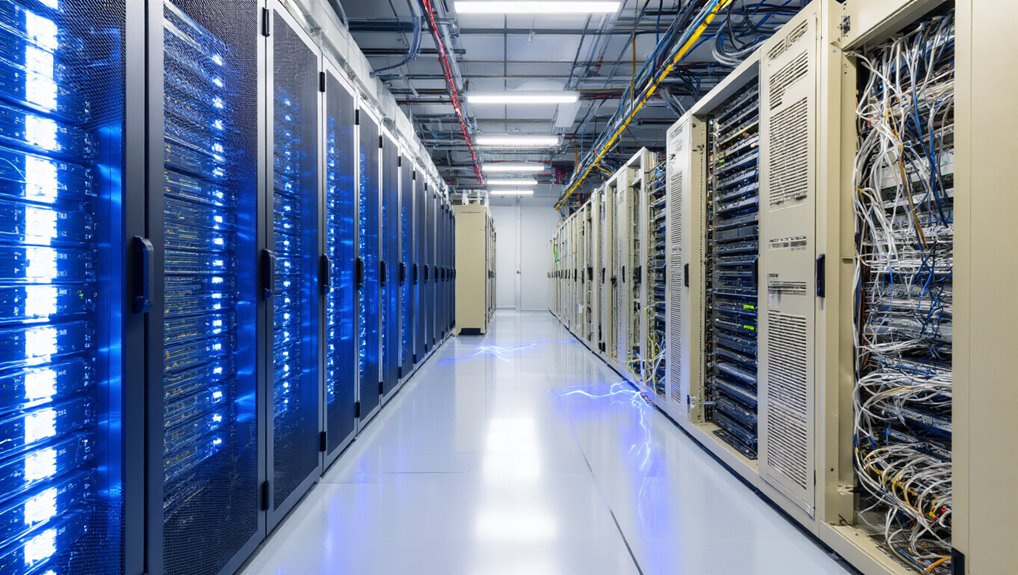

Across boardrooms and engineering teams, artificial intelligence workloads are reshaping how enterprises design their technical infrastructure. The numbers tell a compelling story: inference now accounts for two-thirds of all AI compute in 2026, up from just one-third in 2023. This shift forces you to reconsider everything from chip selection to cloud spending patterns.
Inference workloads doubled their share of AI compute in three years, fundamentally altering chip economics and infrastructure investment priorities.
The inference-optimized chip market has surged past $50 billion in 2026, while total AI cloud infrastructure spending grew 105% year-over-year to reach $37.5 billion. Infrastructure economics have become a first-order architectural constraint. Teams now model inference costs from initial design phases to avoid financial surprises that can derail projects.
Traditional architectures can’t handle this new reality. You need three-tier hybrid systems: public cloud for training, private on-premises infrastructure for inference, and edge deployments for latency-sensitive workloads. This hybrid approach gives you the control of on-premises systems with the elasticity of cloud resources. A unified control plane lets workloads run based on policy, governance requirements, and efficiency metrics rather than infrastructure limitations.
Composable AI stacks replace monolithic designs. You can now build orchestrated systems that distribute work intelligently across multiple models. Routing layers direct tasks to appropriate models based on complexity, cutting inference costs substantially. Model tiers match cost to task value, giving you precise budget control.
Over 60% of enterprise applications embed generative AI by 2026 to augment workflows. Hybrid AI blends predictive analytics, optimization engines, and large language model reasoning. Enterprise applications with task-specific agents jumped from under 5% in 2025 to 40% by the end of 2026.
Efficiency determines which projects survive beyond pilots. Smaller task-specific models handle routine requests while smart routing escalates only complex tasks to larger models. Edge inference reduces cloud dependency for faster response times and cost stability.
Governance separates leaders from laggards. Regulatory frameworks like the EU AI Act demand rigorous, ethical, and transparent practices. You need an enterprise AI roadmap that prevents stalled pilots, regulatory exposure, and duplicated investments. The progression from experimentation to intelligence orchestration at scale with measurable ROI defines 2026’s production maturity shift. iPaaS platforms with pre-built connectors and hybrid support simplify integration across cloud and on-premises systems, speeding deployment and reducing maintenance burdens Integration Platform.