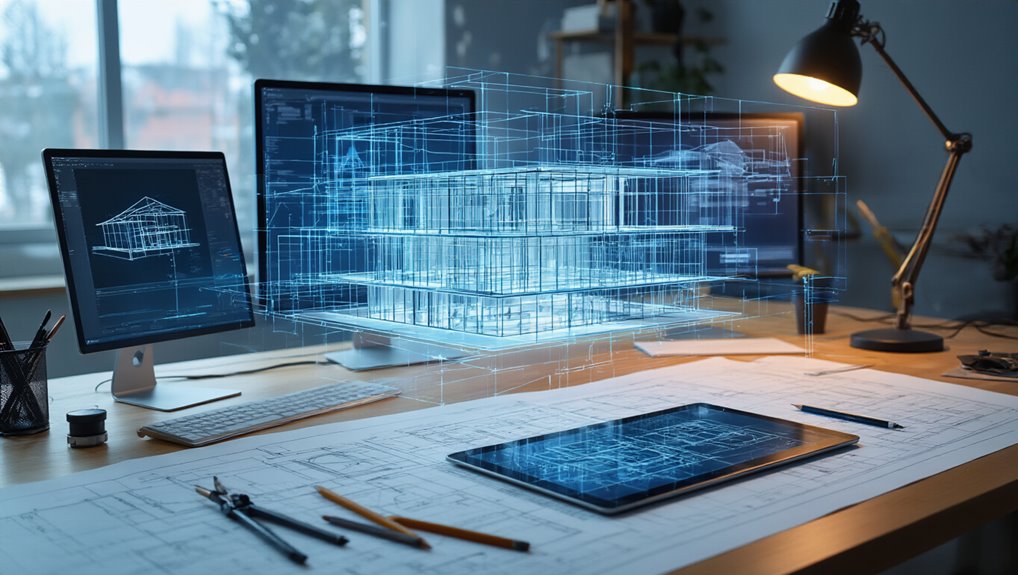

While marketing materials promise revolutionary transformation, the reality of AI integration in architectural practice reveals a more nuanced story of measured adoption and targeted efficiency gains.
AI promises revolution but delivers measured gains in targeted architectural workflows rather than complete transformation.
Current adoption statistics show 46% of architectural professionals using AI tools, with another 24% planning near-term implementation. However, actual workflow acceleration ranges from 20-35%, not the 80-90% reduction vendors advertise. You’ll find these gains concentrate in specific tasks rather than transforming entire project workflows. Studios achieve the most dramatic improvements when AI removes complete workflow steps—moving directly from sketches to usable geometry or linking parametric models with real-time visualization without intermediate stages.
The efficiency benefits appear clearly in routine operations. Scene population and material adjustment now compress multi-step processes while preserving your creative control. Parametric designs evolve 300% faster using AI optimization algorithms compared to traditional methods. Daily usage of AI-powered rendering software reached 27% among US architects in 2023, establishing a baseline before the rapid 2024-2026 advancement period.
Client expectations are reshaping how you should position AI in your practice. Sophisticated real estate clients distinguish between AI-assisted and AI-generated work, specifically requesting traditional 3D workflows with AI augmentation after experiencing revision difficulties with pure AI approaches. Virtual reality integrations with AI enhanced client approval rates by 45%, demonstrating effectiveness when AI augments rather than replaces your existing processes.
The market dynamics demand strategic response. Renderings now available for $15 create intense pressure on mid-market firms to demonstrate value beyond basic visualization. Clients entering with AI-generated concepts push you to prove worth through authored design, contextual reasoning, and informed decision-making.
Your comfort with AI-generated design suggestions likely depends on your firm size. Seventy percent of architects accept AI suggestions, with highest comfort in firms under 20 employees and those exceeding 100 employees. Medium-sized firms (20-99 employees) show more caution due to workflow and client considerations specific to their operational scale. Meanwhile, 55% of innovative projects already use AI for sustainable material recommendations, indicating specialized applications are outpacing general design tool adoption.
Successful API integration can reduce operational costs and improve collaboration when connecting AI tools with firm systems, making integration efficiency a critical consideration for scaling these benefits.