APIs and integration tools deliver significant business value by connecting diverse software applications and streamlining workflows across enterprise systems. These technologies eliminate manual data entry, enable real-time synchronization, and create centralized data sources for improved analytics and decision-making. Organizations benefit from reduced operational costs, enhanced security features, and the ability to scale operations efficiently. Modern enterprises leverage these tools to maintain seamless connectivity across hundreds of applications, opening new possibilities for growth and innovation.
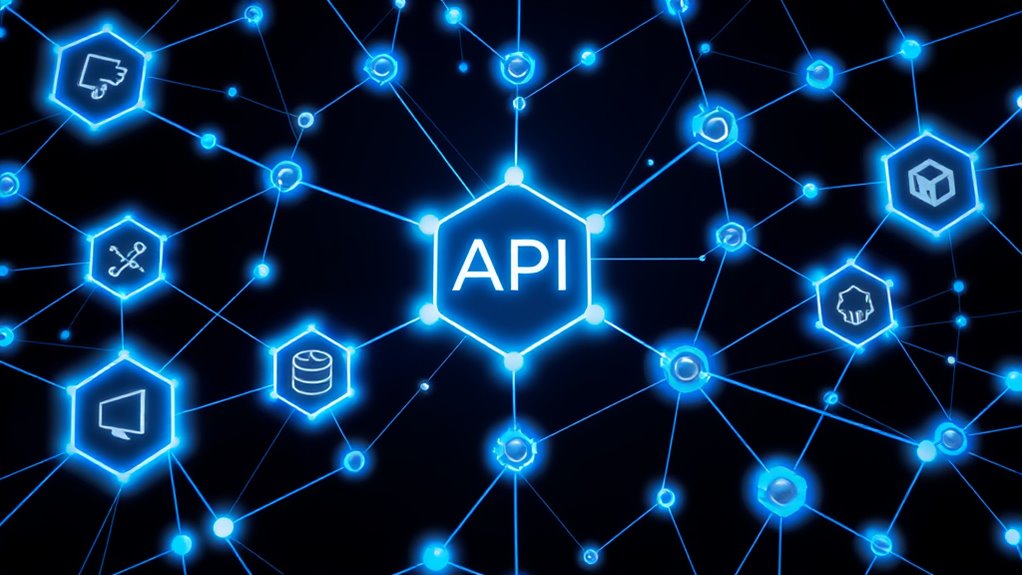
As businesses increasingly rely on digital transformation to stay competitive, APIs and integration tools have become essential components of modern enterprise architecture. These powerful technologies enable organizations to connect diverse software applications, streamline workflows, and create unified data ecosystems that drive operational efficiency. Through pre-built APIs and integration platforms, companies can rapidly expand their business functionality without investing in costly custom development. With 991 applications used by the average enterprise, integration tools are crucial for maintaining seamless connectivity across systems.
The automation capabilities of APIs and integration tools deliver significant operational benefits. By eliminating manual data entry and establishing real-time data synchronization, organizations can reduce errors and accelerate process flows across departments. For instance, customer information automatically updates across connected systems, while help desk tickets seamlessly flow between support and development platforms, enhancing issue resolution efficiency. Drag-and-drop interfaces make it simple for teams to design and implement complex integrations without extensive coding knowledge.
API automation revolutionizes operations by eliminating manual work and enabling real-time data flow, dramatically reducing errors and streamlining cross-departmental processes.
Data integration through APIs creates a centralized source of truth that improves analytics and decision-making capabilities. The automated exchange of structured data between systems ensures consistency and accuracy, while real-time sharing enables greater operational transparency. This integration also supports compliance with data audit requirements and reporting standards across the organization. Third-party services enable businesses to drive innovation and expand capabilities without building everything from scratch.
APIs provide exceptional scalability and flexibility for growing businesses. Organizations can easily add new services and capabilities without overhauling existing infrastructure, handling increased data volumes and user bases smoothly. The modular approach of API integration keeps costs manageable while enabling rapid adoption of new tools and technologies.
Security and compliance considerations are well-addressed through API integration platforms. Built-in security features like encryption and authentication protect data exchanges, while unified data management simplifies regulatory compliance. These platforms also enable consistent security monitoring and secure payment processing across integrated systems.
The financial benefits of API integration are substantial. Organizations can avoid expensive in-house development costs by leveraging third-party APIs, reduce reliance on manual processing tools, and minimize operational expenses through automation.
The consolidation of multiple tools into unified platforms results in lower software spending and more efficient resource allocation, while enabling improved collaboration and faster decision-making through real-time data access.
Frequently Asked Questions
How Much Does It Cost to Implement and Maintain API Solutions?
API implementation and maintenance costs vary greatly based on complexity and scale.
Initial development typically ranges from $2,000 for simple integrations to $30,000+ for enterprise solutions.
Monthly operational expenses include $3,000-$6,000 for maintenance, $500-$2,000 for monitoring tools, and $500-$5,000 for security compliance.
Infrastructure scaling adds 20-40% to costs, while security measures and risk mitigation require an additional 10-15% of the budget.
What Security Risks Are Associated With Using Third-Party APIS?
Using third-party APIs introduces several critical security risks. These include data breaches through compromised external services, unauthorized access due to weak authentication controls, and potential injection attacks from malicious API responses.
Organizations face increased vulnerability when external APIs malfunction or are compromised.
Additional risks involve improper data handling, DDoS attacks targeting API endpoints, and exposure to vulnerabilities in outdated or poorly maintained third-party services.
How Long Does It Take to Integrate APIS Into Existing Systems?
API integration timelines vary considerably based on several key factors.
Simple, single-purpose APIs typically require 3-7 days for implementation, while complex multi-functional systems can take several months.
Well-documented APIs reduce integration time by 40-60%.
Using pre-built connectors and integration tools can compress timelines from months to 1-2 weeks.
Organization structure and clear communication between teams directly impact completion speed and success rates.
Which Programming Languages Are Best Suited for API Development?
Several programming languages excel in API development, each with distinct advantages.
Golang offers superior performance and built-in concurrency support, making it ideal for microservices.
Python, with frameworks like FastAPI and Django REST, enables rapid development and suits data-driven APIs.
Java provides enterprise-grade stability and extensive ecosystem support, while C# delivers strong performance through .NET Core.
The choice depends primarily on project requirements, team expertise, and scalability needs.
Can APIS Work Effectively With Legacy Software Systems?
APIs can effectively integrate with legacy software systems, serving as a bridge between old and new technologies. They enable legacy systems to communicate with modern applications without requiring complete system replacement.
APIs break down data silos, enhance security through encryption protocols, and allow gradual modernization while maintaining business continuity. This approach offers cost-effective solutions by modernizing workflows and connecting existing systems to cloud services and microservices.