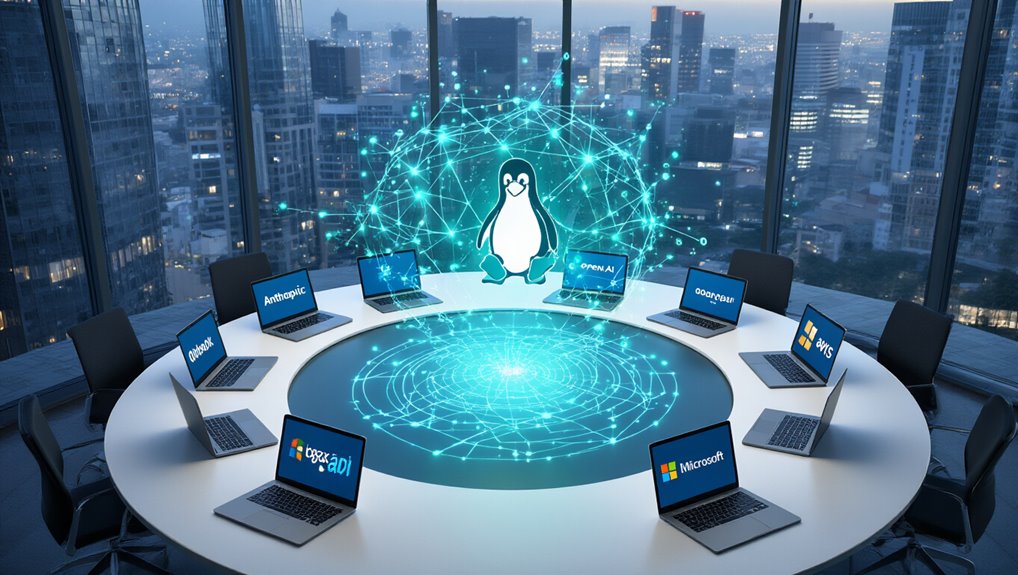
In a surprising move that signals a shift in the competitive AI landscape, major technology rivals have joined forces through the Linux Foundation’s newly announced Agentic AI Foundation (AAIF). The foundation, revealed in December 2025, brings together industry giants Anthropic, OpenAI, and Block under a vendor-neutral consortium focused on creating open standards for agentic AI systems.
The AAIF consolidates several key open-source projects under unified governance. Anthropic has contributed its Model Context Protocol (MCP), which enables agent-to-agent and agent-to-server communication. OpenAI donated its AGENTS.md standard—already adopted by over 60,000 open source projects since its August 2025 release—along with Codex CLI, Agents SDK, and Apps SDK. Block added its Goose framework for agentic workflows.
These technologies collectively define the infrastructure for AI systems that can autonomously plan and execute tasks. The consortium aims to prevent the technological fragmentation that could impede innovation and adoption of agentic AI. The agentgateway project, created by Solo.io and now under Linux Foundation oversight, provides a secure management layer for AI interactions. Contributors including AWS, Cisco, IBM, Microsoft, and Red Hat have joined to support this open collaboration initiative. This technical foundation supports interoperability across repositories and toolchains.
Jim Zemlin, Linux Foundation Executive Director, emphasized transparency as a core principle for the new initiative. The foundation aims to advance open-source agentic AI through shared protocols and libraries while guaranteeing stability and collaborative evolution. Similar to how EDI standards accelerated business operations with data accuracy improvements, these AI standards will ensure reliable agent interactions across platforms.
The impact is already evident in widespread adoption. AGENTS.md has become integrated into numerous development environments including Amp, Codex, Cursor, Devin, GitHub Copilot, and VS Code frameworks. MCP has emerged as critical infrastructure that enables reliable agent behavior across diverse build systems.
This collaboration represents a significant shift from conversational AI toward autonomous multi-agent systems. By standardizing interoperability protocols, the consortium prevents innovation stifling while enhancing security through community scrutiny. The Linux Foundation’s neutral governance model ensures these technologies evolve with global community input rather than being controlled by individual corporations.
For developers, this means more reliable tools, consistent standards, and improved code quality through collective oversight of this rapidly evolving technology.