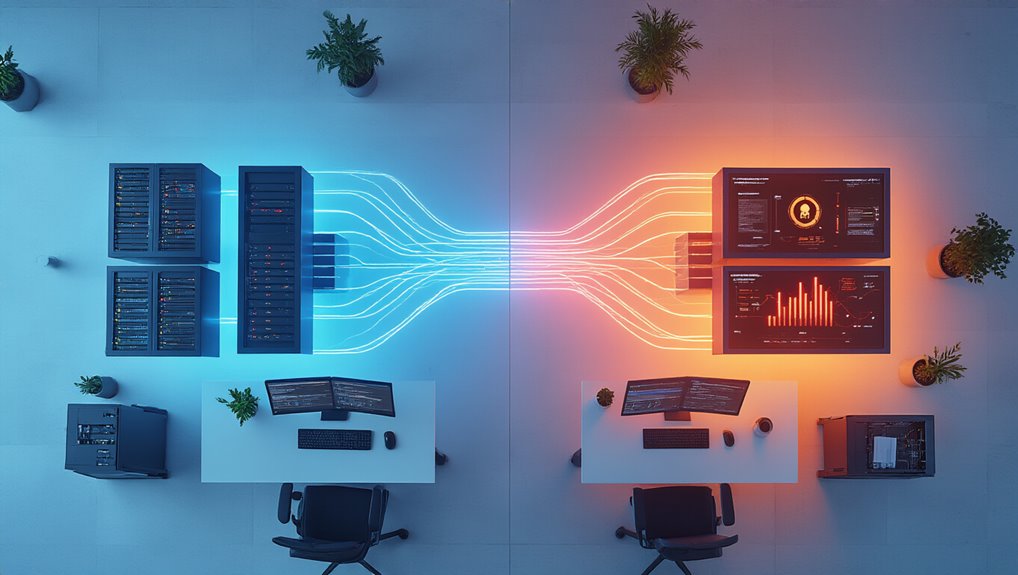
Organizations are abandoning isolated cybersecurity approaches in favor of collaborative defense strategies that leverage shared intelligence and government partnerships. The data reveals a stark division: large organizations with over 100,000 employees show 49% engagement with government agencies and information-sharing groups, while smaller organizations with fewer than 1,000 employees achieve only 26% engagement. This disparity matters because resilience depends on collective intelligence rather than standalone defense mechanisms.
Large enterprises engage with threat-sharing partnerships at nearly double the rate of smaller organizations, exposing a dangerous collaboration gap in collective defense.
The correlation between collaboration and security maturity is undeniable. Only 6% of CEOs from insufficiently resilient organizations report working with government agencies.
Geopolitical volatility drives this strategic shift, with threat intelligence and government engagement ranking as the top two factors reshaping cybersecurity strategies. Large organizations face direct geopolitical pressures due to their global operations, while smaller entities with limited geographic footprints often remain unaware of these threats.
Artificial intelligence has emerged as both a challenge and a solution. The percentage of organizations evaluating AI tool security nearly doubled from 37% in 2025 to 64% in 2026, with 94% of respondents identifying AI as the most significant driver of change in cybersecurity. Organizations are implementing AI for phishing detection (52%), intrusion response (46%), and user-behavior analytics (40%).
However, implementation reveals critical vulnerabilities: 97% of organizations experiencing AI-related incidents lacked proper access controls, and 63% had no governance policy preventing unauthorized shadow AI.
The speed and sophistication of AI-powered attacks overwhelm traditional defenses. You need to recognize that 76% of global organizations struggle to keep pace with these threats, while 89% view AI-powered defenses as necessary countermeasures.
When IT and security teams operate separately, organizations cannot effectively manage these complex challenges. Qualys enables you to forge shared goals by providing unified visibility across your infrastructure, facilitating the collaboration essential for modern cyber resilience. Intelligence-driven partnerships have become indispensable as threats rise and technology divides widen, making isolated operations increasingly untenable in today’s fragmented security landscape. Integrated ITSM solutions can reduce downtime by up to 30% through automation and unified workflows, highlighting why cross-team integration is critical reduced downtime.