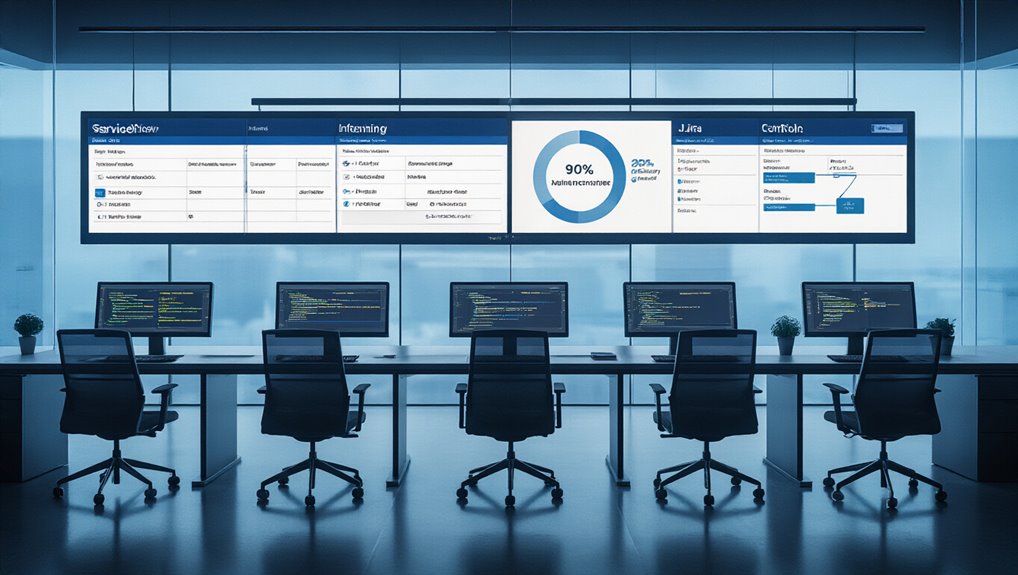
The integration between ServiceNow and Jira Service Management (Jira SM) has evolved considerably, enabling organizations to abandon complex coding practices in favor of streamlined connection frameworks. These modern integration approaches eliminate manual double data entry through real-time synchronization, notably reducing human errors while accelerating issue resolution. Organizations implementing these solutions report up to 90% reduction in maintenance overhead compared to traditional point-to-point coded integrations.
Modern integration eliminates double entry, reducing errors and cutting maintenance overhead by 90% compared to traditional coding methods.
Teams experience substantial efficiency gains when adopting these no-code integration solutions. By automating repetitive tasks, organizations increase team capacity and enable faster responses to tickets and issues across platforms. The seamless connection between Jira agile boards and ServiceNow ITSM activities creates unified workflows that prevent rework caused by miscommunication between IT and development teams. The integration provides complete visibility across incident management modules that sync ServiceNow incidents with Jira tickets for joint resolution.
This integration extends beyond basic ticket synchronization to support extensive change tracking from ITSM to development pipelines. Comprehensive security features ensure that data integrity standards align with enterprise and FinTech requirements during synchronization processes. Implementing field-level security measures protects sensitive information while maintaining seamless data flow between systems.
The collaboration benefits extend across departments, bridging IT, development, and business units with shared visibility and accountability. Stakeholders access consistent information without platform-switching, while supporting diverse teams including contractors and vendors working in different tools. These integrations facilitate workflows beyond IT, empowering departments like HR, legal, and marketing through shared service management capabilities.
Out-of-the-box connectors and integration platforms such as Getint.io and Planview Hub provide low-code or no-code options that drastically reduce implementation time and risk. These solutions eliminate reliance on specialized developer resources, lowering the total cost of ownership while speeding deployment. Organizations avoid the common pitfalls of custom coding that traditionally delayed projects and increased support requirements.
The scalability advantages are particularly compelling as centralized, model-based integration frameworks adapt quickly to changing process needs without major recoding efforts. This approach prevents integration decay and technical debt accumulation seen with hard-coded connections.
Smart teams recognize these benefits and increasingly choose these modern integration methods, achieving faster time-to-value and greater operational efficiency while maintaining the flexibility to use preferred tools across their organization.