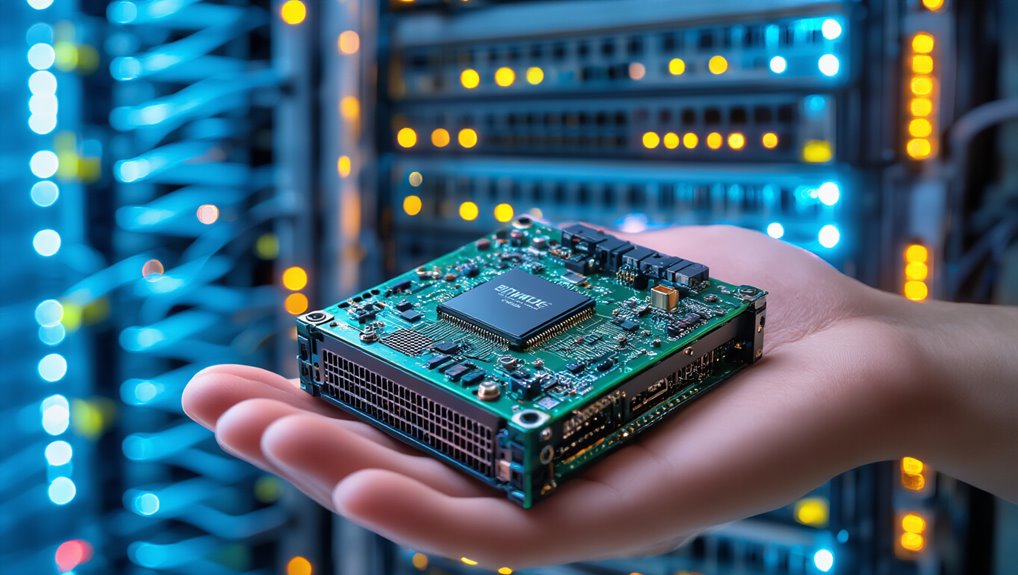

In the rapidly evolving world of artificial intelligence, a fundamental shift is challenging the assumption that bigger always means better. While large language models like GPT-4 boast over 200 billion parameters, tiny models with as few as 7 million parameters are delivering remarkable results that could transform how you approach AI deployment in your business.
The performance gap between small and large models is narrowing dramatically. Samsung’s TRM, with just 7 million parameters—0.01% of leading LLMs—sets state-of-the-art results on the ARC-AGI intelligence test. Phi-4-Mini matches or outperforms GPT-4 on reasoning and coding benchmarks despite being appreciably smaller. When you fine-tune small models for specific domains like healthcare or legal analysis, they often exceed large models in accuracy. iPaaS platforms also simplify integrating models into enterprise systems by providing pre-built connectors and scalable orchestration.
Speed advantages make small models particularly valuable for real-time applications. You’ll see response times of 50-200 milliseconds with small models compared to 2-8 seconds for their larger counterparts. Phi-4-mini-flash-reasoning delivers 10x higher throughput and 2-3x lower latency while maintaining strong reasoning capabilities.
This speed enables you to build responsive chatbots, instant code completion tools, and interactive customer service systems.
Cost efficiency represents another compelling advantage. Fine-tuning small models costs hundreds of dollars over days, while large models require thousands. You’ll dramatically reduce both training and inference costs due to fewer parameters, and operational overhead drops substantially when deploying small models instead of resource-intensive LLMs. Retrieval-Augmented Generation (RAG) keeps models lightweight while ensuring they remain informed and accurate by accessing external knowledge sources. Quantization techniques can reduce model size by 75% with minimal performance loss, making deployment even more practical.
Deployment flexibility and privacy protection further strengthen the case for tiny AI. You can run small models on local machines, edge devices, or smartphones without requiring substantial computing resources. This enables on-device processing that protects sensitive data without cloud dependency—critical for industries handling confidential information.
Small models excel at domain-specific tasks like FAQs, chatbots, and code snippets where specialization matters more than broad knowledge. While large models retain advantages for complex, multi-domain applications, the combination of speed, cost savings, privacy protection, and targeted performance makes tiny AI models increasingly attractive for delivering measurable business value in focused applications.