How effectively are service teams managing their ever-growing workload in today’s fast-paced digital environment? For many organizations, the answer lies in smart automation and playbooks within Jira Service Management, tools that have fundamentally transformed incident management processes.
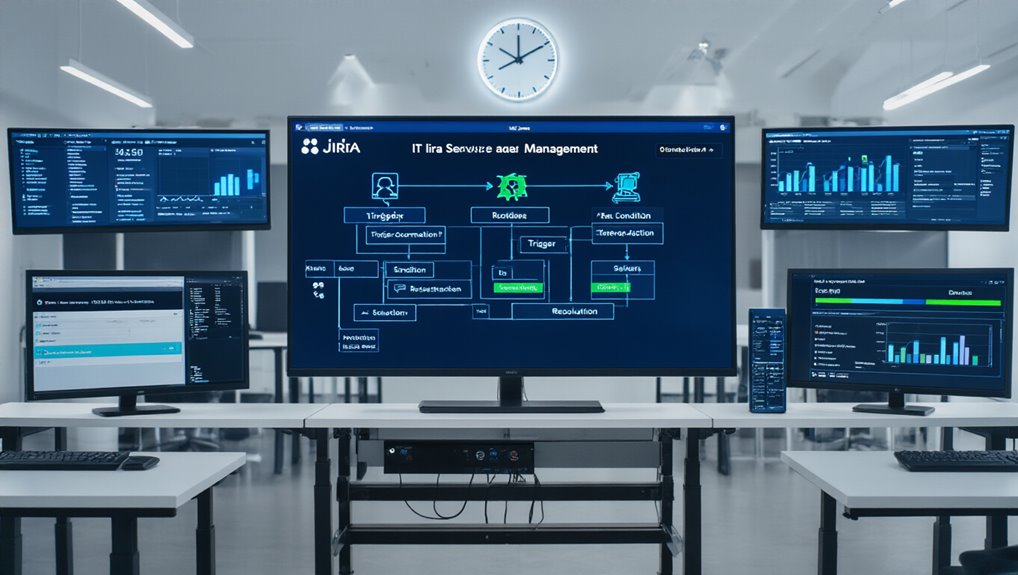
Automation rules serve as the backbone of efficient incident management, consisting of triggers, conditions, and actions that handle repetitive tasks automatically. When critical incidents occur, automation accelerates escalation by sending immediate notifications to relevant stakeholders, updating statuses, and creating necessary tasks—all without manual intervention. This systematic approach guarantees consistency while reducing the manual workload that often overwhelms service teams.
Playbooks complement automation by providing structured guides for agents during incident resolution. These step-by-step workflows combine clear instructions with automated actions, ensuring teams follow established processes every time. Project administrators can create, monitor, and enforce these playbooks, while execution logs maintain complete traceability of all actions taken during an incident. Teams can access automation features by navigating to Project settings in the left-hand menu of their Jira Service Management interface.
The results of implementing these tools are measurable and significant. According to Forrester research, organizations using Jira Service Management’s automation and AI capabilities have achieved a remarkable 275% ROI and saved approximately $2.3 million. These savings come from improved time to resolution and reduced operational costs. The platform’s point-and-click customization capabilities allow teams to tailor workflows and automation rules without requiring coding expertise.
Recent enhancements have made these tools even more powerful:
- AI-assisted automation rule creation using natural language inputs (coming in 2025)
- Smart Buttons in Confluence for non-technical users to trigger automations
- Virtual Service Agents that automate responses with AI-driven intent flows
- Integration with external systems like Okta for user account automation
For teams seeking to improve their incident management processes, the path is clear. Start by identifying repetitive tasks that could benefit from automation. Then, create standardized playbooks for common incidents to ensure consistent handling. Use smart values like {{issue.key}} to personalize messages and build complex rules that adapt to different scenarios. Implementing these solutions aligns perfectly with strategic IT objectives, allowing organizations to achieve operational cost savings of 20-40% while maintaining high service quality standards.
The result will be faster resolution times, improved SLA adherence, and more efficient service delivery.