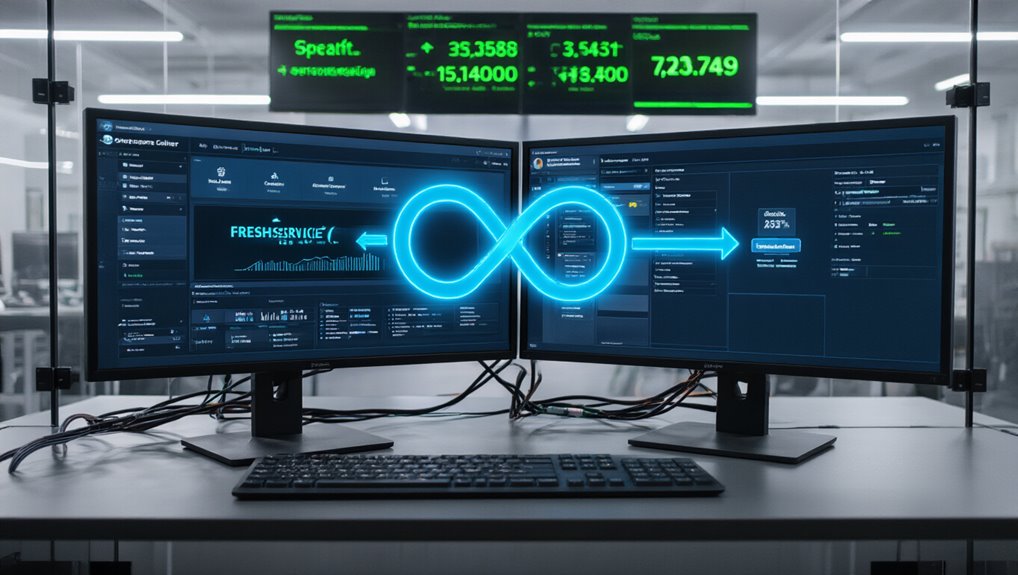
While organizations increasingly rely on specialized ITSM tools to manage their IT operations, many face substantial challenges when different departments use separate platforms. The integration between Freshservice and ServiceNow offers a compelling solution by creating seamless workflows that connect these powerful ITSM systems. This synchronization eliminates the barriers typically encountered when teams operate in isolated environments.
Breaking down platform silos through integration creates unified ITSM environments where teams can collaborate seamlessly regardless of their tools.
The connection between these platforms enables automatic ticket routing and comprehensive asset management. IT teams benefit from bi-directional synchronization that keeps ticket information and asset data current across both systems. When an incident is logged in Freshservice, it can instantly appear in ServiceNow, allowing specialists in either system to address issues without duplicating efforts. This automation markedly reduces manual workloads and accelerates resolution times. Companies implementing integrated systems experience a remarkable 92% lower churn rate compared to those with disconnected solutions.
Collaboration improves dramatically when service desk teams can work together regardless of their preferred platform. The integration breaks down communication silos, providing visibility into ticket status and ownership for all stakeholders. Teams can coordinate more effectively, resulting in faster incident resolution and more efficient change approval processes. Customers ultimately experience better service delivery with consistent, timely responses to their IT needs.
Operational efficiency gains stem from automated workflows that eliminate repetitive data entry tasks. Custom “recipes” can be configured to trigger specific actions based on events in either system. For instance, when asset information updates in ServiceNow, the corresponding records in Freshservice reflect these changes automatically. Real-time webhook triggers execute after record save to instantly synchronize data between systems. This frees IT staff to focus on solving complex problems rather than administrative tasks. ZigiOps integration provides no-code implementation that makes these complex connections accessible without specialized programming expertise.
The consolidated approach to asset and change management ensures both platforms maintain synchronized inventory records and consistent approval workflows. Additionally, comprehensive reporting capabilities provide insights across the integrated environment, helping teams identify bottlenecks and optimize processes. Organizations can track SLAs, monitor performance metrics, and make data-driven decisions from a unified perspective.
This integration scales with organizational growth and adapts to evolving ITSM requirements, future-proofing IT operations while maintaining consistent service delivery during transitions or platform changes.