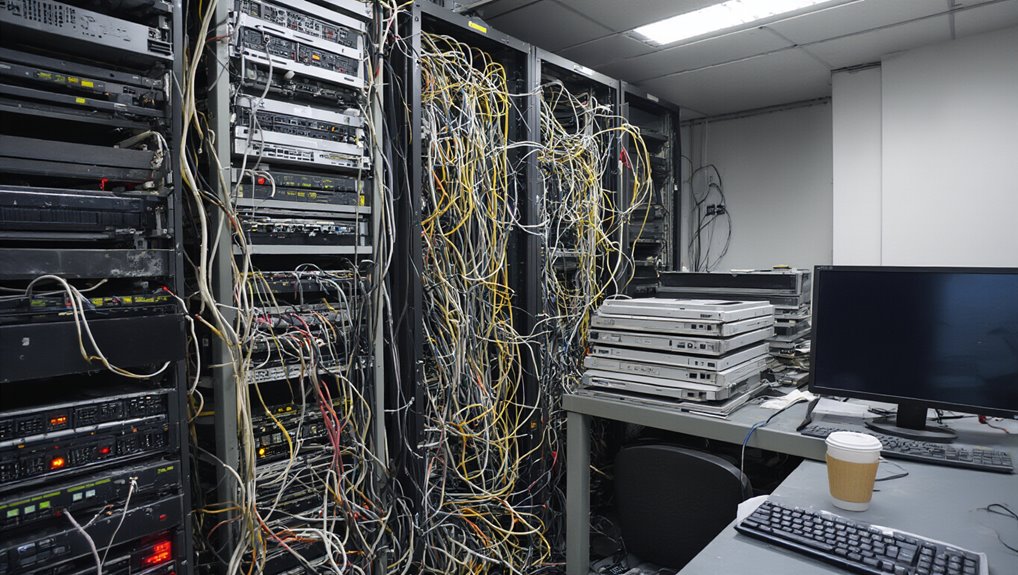
The Real Cost of Poor Digital Employee Experience
Poor digital employee experience carries measurable financial consequences that extend far beyond IT budgets. McKinsey reports disengaged employees cost businesses $450–$550 billion annually. Lost productivity costs U.S. businesses alone $1.8 trillion each year. These figures reflect compounding losses across recruitment, retention, and daily output.
Consider a 100-person organization where each employee loses three hours weekly to digital friction. That equals 300 lost productive hours weekly—equivalent to seven full-time employees producing nothing. Organizations that invest in process transformation can recapture significant portions of that lost productivity.
Meanwhile, 29% of organizations directly link poor digital experiences to employee departures, triggering replacement costs ranging from $1,500 for hourly roles to 213% of salary for executives.
The UK average cost of turnover per employee stands at £30,614, a figure that compounds significantly when organisations with turnover rates above 15% are also contending with poor digital employee experience. Compounding this further, low engagement costs the global economy $8.1 trillion, underscoring that poor digital employee experience is not a localized business problem but a worldwide economic crisis.
How Much Productivity Your Business Is Actually Losing to IT Friction
The financial toll of disengagement only tells part of the story. IT friction quietly drains productivity at every level of an organization. Employees lose up to two hours daily negotiating inefficient systems and unclear processes. That loss compounds fast across entire workforces. Effective automation and integration can recapture much of this lost time by streamlining workflows and reducing manual handoffs.
Key friction sources include:
- Technology overload: 69% of organizations run too many platforms, slowing operations
- Poor communication: 41% of friction complaints trace back to unclear information sharing
- Decision delays: Repeated approval loops waste time and erode team trust
- Complex processes: 25% of complaints stem from overcomplicated internal workflows
These compounding losses are no small matter. Harvard Business Review estimates that organizational friction costs the global economy more than $3 trillion per year in lost output. In fact, 88% of workers, managers, and executives report experiencing friction in their work environment, confirming that productivity loss from friction is not an isolated problem but a near-universal organizational reality.
How Tech Frustration Drives Turnover: and What It Costs to Replace Those Employees
Workplace technology frustration does more than slow employees down — it pushes them out the door entirely.
Research shows 28% of employees have considered quitting specifically because of tech frustration, and 69% of organizations confirm digital friction contributes to turnover. A global study of 4,200 employees and managers across nine countries underscores just how widespread this problem has become. Outsourcing decisions increasingly aim to address such digital friction by providing specialized talent to improve employee experience and system reliability.
When employees leave, replacement costs are significant:
- Average replacement cost: $34,204 per employee
- Salary-based cost range: 50%–200% of annual salary
- 1,000-employee organizations with 17% turnover spend $5,814,680 annually on replacements
Beyond direct costs, new hires take 3–6 months to reach full productivity, multiplying losses further with every departure. Compounding these challenges, businesses are projected to lose $430 billion by 2030 due to low talent retention across industries.
What Technostress Is Doing to Your Workforce and Your Bottom Line
Technostress — the strain employees feel when overwhelmed by digital tools, constant notifications, and poor system design — carries measurable costs that extend well beyond individual discomfort.
The organizational damage spans multiple categories:
- One in three employees experiences burnout from constant connectivity demands
- 47% struggle to identify security threats due to information overload
- 23% want to quit because of technology-related stress
- Unplanned absenteeism driven by technostress costs businesses $600 billion annually
These numbers compound quickly.
Burned-out employees miss more work, make more security mistakes, and leave more often.
Each outcome carries direct financial consequences that organizations can no longer afford to overlook. Active AI users experience burnout at rates 45% higher than their non-AI-using counterparts, signaling that the newest wave of workplace technology is accelerating the problem rather than relieving it.
Beyond burnout alone, technostress manifests across five distinct patterns — including techno-overload, techno-invasion, techno-complexity, techno-insecurity, and techno-uncertainty — meaning that poor digital experiences can erode performance, confidence, and retention through multiple converging pathways simultaneously. Improved visibility and control through ITSM integration can help organizations proactively address these issues.
How to Build the Business Case for Digital Employee Experience Investment
Burned-out, disengaged, and overwhelmed employees represent a financial liability — but they also represent an argument. Use that argument to secure investment. A strong business case connects digital employee experience directly to measurable outcomes:
- Turnover costs: £30,000 per replacement, 28 weeks of lost productivity
- Profitability: Highly engaged teams outperform disengaged ones by 21%
- Savings potential: Integrated platforms can liberate up to $10 million for large enterprises
Frame the investment as strategic, not operational. Speak stakeholders’ language — cost reduction, efficiency, competitive advantage. Pair quantitative metrics like adoption rates with qualitative data from ongoing employee surveys to demonstrate clear, trackable value. Avoid conjecture by grounding every claim in statistics and available data rather than opinion or incomplete information. Research from Gallup across 1.8 million employees and 230 organizations found that higher engagement scores were directly tied to 70% fewer workplace safety incidents. Implementing standardized ITSM practices can also deliver measurable efficiency gains and cost savings, as shown by widespread reductions in service problems and security incidents ITSM benefits.