



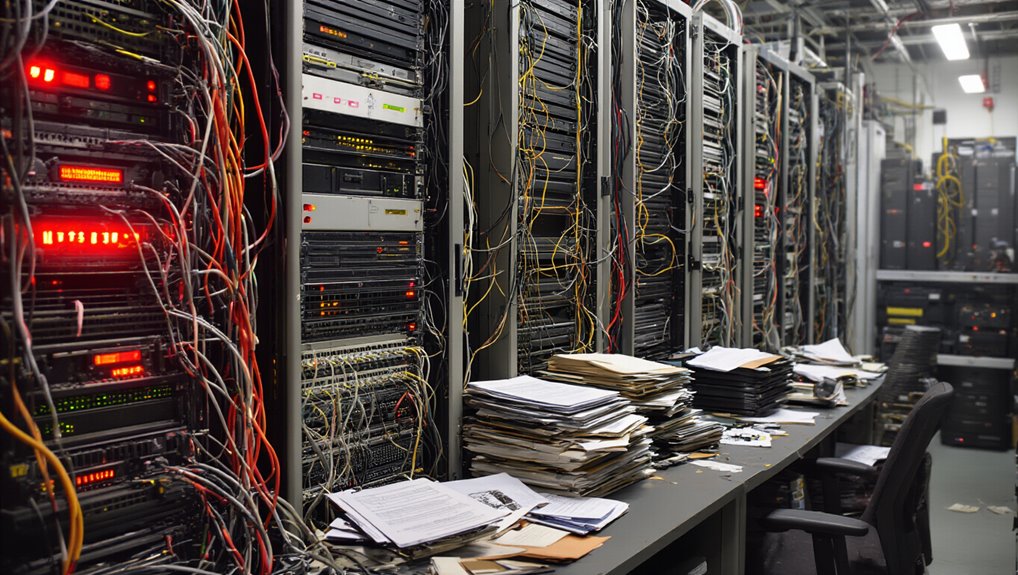
Why Missing Asset Context Slows Every Ticket Down
Without accurate asset context, every ticket that enters the service desk carries an invisible tax — time lost to manual investigation before any real troubleshooting begins.
Technicians spend valuable time tracking down basic device details instead of solving the actual problem. This is why a single source for critical data assets matters across support teams.
Missing information about specifications, ownership, and operating systems forces guesswork during triage.
This detective work compounds quickly when multiple tickets share the same information gaps across disconnected systems.
The result is predictable:
- Escalations increase
- First-contact fix rates decline
- Resolution time stretches unnecessarily
Incomplete asset visibility doesn’t just slow one ticket — it systematically undermines every incident the service desk handles. Organizations with a strong incident plan and thorough asset discovery have seen breach costs reduced by 61%, saving over $2.6 million compared to the global average. Better visibility addresses the root cause of delays far more effectively than faster escalations or additional technician training alone.
How Recurring Incidents Stay Hidden Without ITAM
Many recurring incidents go undetected not because the patterns are subtle, but because the data needed to connect them simply doesn’t exist in one place. Without ITAM, teams lack the asset history required to spot repeated failures tied to the same configuration, dependency, or component.
Several gaps drive this:
- Incident tickets repeat without linking to root problems
- Follow-up tasks sit in backlogs, deprioritized against feature work
- Blame-focused reviews hide systemic causes
- Postmortems lack detailed root causes, leaving triggers undocumented
Each incident gets treated as isolated. The pattern stays invisible, and the same failures keep occurring. When incidents do not capture the impacted service and configuration item, the platform cannot route triage to real owners or surface recurring patterns across services. Organizations that close this gap report a 40–60% reduction in repeat incidents within the first year. Implementing a centralized configuration management approach helps teams link incidents to specific assets and reveal underlying trends.
What Poor Triage and Misclassification Cost Your Team
Misclassifying an incident doesn’t just slow down resolution—it triggers a chain of compounding costs that affect personnel, budgets, and service reliability. IBM data shows unresolved incidents cost roughly $800 per hour. Poor classification extends that window unnecessarily. Centralized data and real-time access to accurate information can shorten decision cycles and prevent escalation.
The damage compounds across three areas:
- Personnel waste: Mislabeled bugs pull senior engineers into low-priority work
- Budget exposure: Fines and accreditor penalties follow noncompliance with classification standards
- Response capacity: Bottlenecks form when severity levels don’t match actual urgency
Organizations improving classification accuracy report MTTR dropping from six hours to thirty minutes—translating to roughly $352,000 in annual risk reduction. AI can automate investigations, evidence collection, prioritization, and triage to further reduce these costs, making alert volume and severity rate the foundation of any defensible ROI calculation.
Research in trauma care systems demonstrates a parallel dynamic: when low-risk patients are overtriaged to major trauma centers, acute injury costs rise 40%, exposing the same fundamental principle that mismatching resource intensity to actual need drives avoidable expenditure at scale.
What ITAM Actually Does for Incident Resolution
The hidden cost of poor incident classification makes one thing clear: faster, more accurate resolution depends on better information at the point of triage. ITAM delivers that information directly. When a ticket opens, asset data automatically populates the workflow — device type, location, user context, warranty status, and repair history. Technicians skip the back-and-forth. They diagnose faster.
ITAM also continuously scans networks for unauthorized devices, rogue applications, and anomalies. Alerts reach response teams immediately with full context. Asset ownership records identify affected stakeholders instantly, ensuring proper escalation. Criticality ratings then determine priority, so high-impact incidents receive appropriate resources without guesswork. When access to a platform is blocked, security services like Cloudflare capture identifying details such as Ray IDs and visitor IPs to support incident investigation and resolution. Strong data integrity practices, including validation procedures, ensure the asset data feeding these processes is accurate and reliable.
Data breaches carry significant financial consequences, with the global average reaching $4.35 million in 2022 and the U.S. average climbing to $9.44 million — costs that integrated ITAM helps reduce by enabling faster containment and lessons learned to prevent repeat incidents.
How ITAM Makes Your Service Desk Predictive
Reactive service desks wait for things to break — predictive ones stop breakdowns before they start. ITAM transforms service desks by feeding historical asset data, IoT signals, and performance trends into AI models that forecast failures before they escalate.
- Predicts device failures using real-time IoT and performance data
- Reduces MTTR by 50–70% within the first six months
- Correlates related alerts into single incidents, cutting resolution time by 40%
- Catches issues before SLA breaches occur through predictive monitoring
Machine learning continuously refines these forecasts, making every incident resolution cycle smarter than the last. Condition-based maintenance strategies assess real-time wear and tear to optimize maintenance timing, extending equipment lifespan by 20% and reducing maintenance costs by 25%. Without AI-powered automation, alert volume and speed quickly exceed human triage capacity, leaving engineers overwhelmed and SLA compliance at risk. Modern ADP platforms also enable this by automating data collection and transformation into analysis-ready formats, providing a single unified view of assets and incidents through data integration.