


Cyber Resilience Means Keeping Services Running, Not Just Blocking Attacks
In today’s threat landscape, cyber resilience is defined as the ability to keep critical services running during and after a cyberattack — not simply the ability to block one. Traditional security focuses on prevention. Resilience goes further. It prepares organizations to:
- Respond quickly when attacks succeed
- Recover operations with minimal downtime
- Adapt processes after ransomware, breaches, or infrastructure failures
Security controls still matter. However, resilience extends into incident response, recovery, and business continuity planning. A resilient organization accepts that some attacks will land — and builds the operational capacity to absorb disruption without losing critical service delivery.
Bad actors use malware, ransomware, back doors, and malicious tools that can cause days, weeks or longer of disruption to business operations. Achieving this level of operational readiness requires more than internal effort alone. Organizations benefit from working alongside 7,500+ cyber resilience professionals and a broad partner ecosystem to design, implement, and operate security-rich environments that hold up under real-world pressure. Service request management also helps ensure continuity by streamlining workflows and improving visibility across IT operations.
Which Business-Critical Services Deserve Protection First
Not every system carries the same weight.
Organizations should prioritize protection in this order:
- Internet-facing services — Web applications, DNS servers, and firewalls directly control whether customers and staff can reach anything else. Many organizations use centralized incident management to ensure these services are monitored and quickly restored when disrupted.
- Financial and transaction systems — Payment platforms and billing engines average nearly $9,000 per minute in downtime costs.
- Communications infrastructure — Telephony and voice services keep incident response teams coordinated when other channels fail.
Protecting these three layers first preserves revenue, coordination, and access simultaneously. For organizations operating within government or critical infrastructure sectors, Priority Telecommunications Services provide a federally backed safety net that keeps essential voice and data circuits functional even when commercial networks become congested or degraded.
Determining which assets fall into these categories is not guesswork — business impact analysis serves as an integral part of the cyber risk management process, systematically identifying the most critical functions and applications before a disruption forces those decisions under pressure.
Build the Continuity Controls That Keep Critical Services Online
Defining what “online” actually means for each critical service is the foundation of cyber-resilient continuity planning. Organizations must establish RTO and RPO targets before building controls around them.
From there, continuity controls should address three layers:
- Architecture resilience – Deploy redundant systems, failover routing, and segmented environments to isolate incidents.
- Data protection – Maintain verified, clean backups stored separately from primary systems to prevent simultaneous compromise.
- Formalized playbooks – Document roles, escalation paths, and restoration sequences for realistic attack scenarios.
Test these controls regularly. Gaps discovered during exercises cost far less than gaps discovered during an actual attack. Once inside a network, attackers can achieve lateral movement across more than 60% of an environment in under an hour, making pre-validated containment and restoration procedures a non-negotiable component of any continuity program.
A Strategic Business Impact Analysis conducted through structured workshops helps organizations identify and prioritize their most critical processes, ensuring that continuity controls are built around the operations that matter most. Effective continuity planning also depends on maintaining data integrity so that backups and recovery targets reliably restore accurate, complete, and consistent information.
Detect Threats Faster Before They Take Down Your Services
Continuity controls only hold if threats are caught early enough to act on them. Security teams that detect intrusions faster limit data loss, downtime, and recovery costs before damage spreads.
Three detection capabilities drive faster discovery:
- SIEM, EDR, and XDR aggregate logs and monitor endpoints, networks, and cloud workloads for abnormal activity.
- AI and threat intelligence identify subtle anomalies and reduce mean time to detect by up to 63%.
- SOAR automation executes containment steps within minutes, cutting mean time to respond by up to 70%.
Continuous monitoring and proactive threat hunting close remaining gaps. Ransomware and phishing campaigns operate at machine speed, often fully automated, making human-only monitoring insufficient to match the pace of modern attacks. Without this speed, organizations risk falling into the pattern where detection and containment still consume an average of 277 days, leaving attackers free to escalate damage long after the initial breach. Implementing robust encryption across integrations and data flows helps prevent attackers from exploiting insecure transfers during an incident.
Why Third-Party Risk Can Collapse Your Cyber Resilience Plan
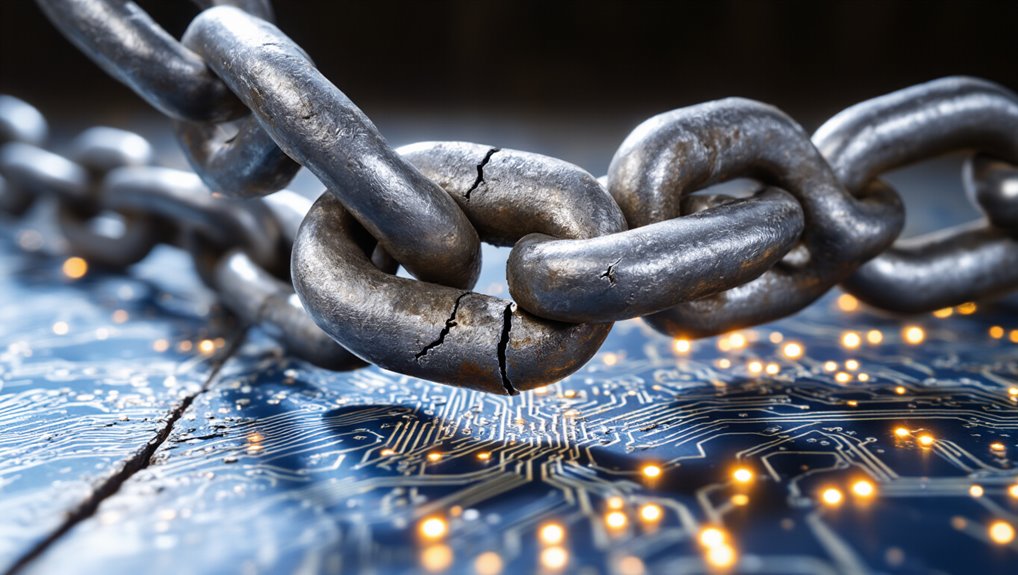
Even the strongest internal security posture can unravel when a vendor fails. Third-party risk accounted for 31% of all cyber insurance claims in 2024, rising from nearly zero the year before. That shift signals a structural problem. Organizations depend on cloud providers, SaaS platforms, and software integrations that sit inside critical workflows. When one vendor fails, recovery depends on their timeline, not yours. Key vulnerabilities include:
- Privileged vendor access to sensitive systems
- API integrations targeted in supply-chain attacks
- Outages causing downstream failures without any internal breach
Static audits and questionnaires cannot keep pace with these fast-moving risks. Recent analysis found that third-party involvement contributed to 30% of breaches, roughly double the rate seen in prior years. Third parties expand the attack surface by having access to sensitive data and critical systems, meaning a single compromised vendor can serve as an entry point that bypasses even mature internal defenses. A single vendor breach can trigger cascading operational disruptions across every downstream system and workflow that depends on it. Effective vendor selection and continuous monitoring are required to sustain operational resilience.