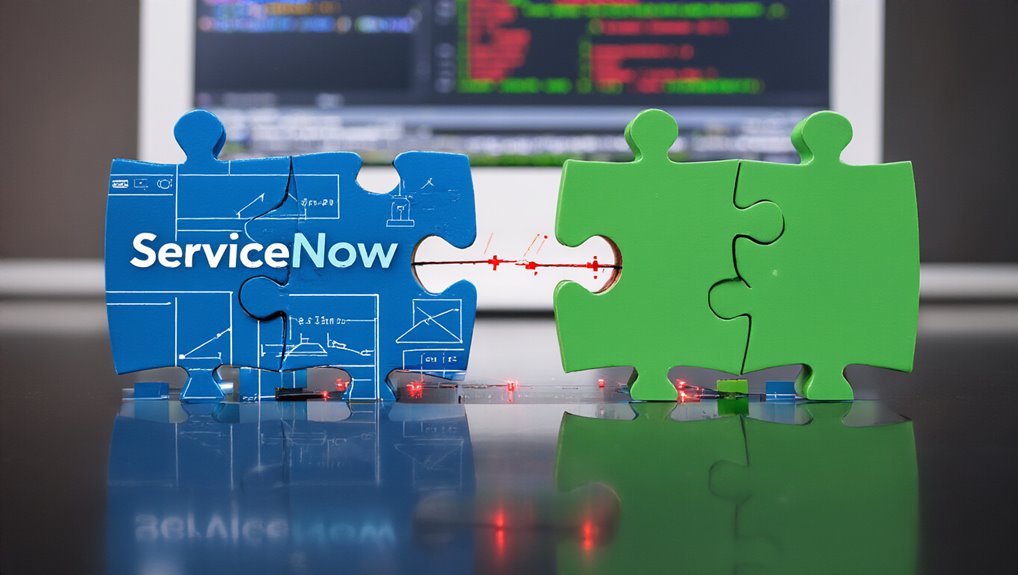
Why do organizations struggle to maintain seamless synchronization between ServiceNow and Jira platforms? The challenges stem from technical, operational, and process-related issues that create barriers to effective integration. When field mappings don’t align properly between systems, critical information gets lost or corrupted during transfers. This misalignment is compounded by inconsistent workflows that interrupt the smooth flow of data between IT service management and development teams. Multiple organizations use siloed Jira and ServiceNow instances, causing version mismatches, missing comments, and attachment issues.
The integration gap between ServiceNow and Jira creates costly information silos that undermine both service management and development workflows.
Proper integration faces several core technical hurdles. Systems must reconcile complex data format differences including time zones, dropdown values, and attachments. Simultaneous updates from both platforms create conflict scenarios without clear resolution paths. Organizations frequently encounter issues with incorrect endpoint details that lead to authentication failures and broken connections. Large enterprises face additional complexity when managing multiple instances of both tools across different business units. Implementing robust contractual safeguards with detailed SLAs can help mitigate these integration challenges and establish clear performance expectations.
The consequences of failed synchronization are measurable and significant:
- Incident resolution times increase by up to 30%
- Operational costs rise by approximately 25% due to redundancies
- SLA commitments face higher risk of being missed
- Teams lose visibility into critical updates
- Customer satisfaction decreases as issues take longer to resolve
Organizations often make critical mistakes during implementation. Many rely on manual workarounds rather than automated solutions. Others fail to align team workflows alongside system integration. The most common error involves attempting custom API integrations without accounting for error handling and recovery mechanisms.
Enterprises that achieve successful bi-directional integration follow established best practices:
- Implement flexible integration platforms with customizable field mappings
- Establish clear sync rules to prevent data conflicts
- Clean data before integration to prevent error propagation
- Align team processes alongside system integration
- Test extensively with realistic conflict scenarios
Effective integration platforms deliver several key capabilities: real-time bidirectional synchronization, robust error handling, support for complex data types, conditional logic for priority escalation, and comprehensive audit trails.